Ancient DNA and historical genomics
Old DNA is damaged, fragmentary, and usually contaminated with everyone who has handled the object since. What makes these projects worth the trouble is that a named individual from the past is one of the few cases in population genetics where the answer can be checked against something outside the genetics. The archive says who this person was. The genome either agrees or it does not.
Beethoven
In 1802, Beethoven asked that his illness be described and made public after his death. Medical biographers have argued about it ever since, proposing a long list of heritable conditions to explain his progressive deafness, chronic gastrointestinal complaints, and liver disease. The arguing continued for two centuries because there was nothing to settle it with.
The study analyzed eight locks of hair attributed to him. Five turned out to come from a single European male, and the overlap between independent provenance chains made those five almost certainly authentic. The other three were not his, which is a useful result in its own right about how relics circulate and get relabeled. From the authentic samples the team sequenced a genome at 24-fold coverage, which is a serious genome by any standard and remarkable from historical hair.
Two findings drew most of the attention. The genome carried strong genetic risk for liver disease, and hepatitis B infection was detectable in the months before his death. Together with documented alcohol consumption, that offers a plausible account of the liver failure that killed him. Neither the deafness nor the gastrointestinal complaints had an obvious genetic explanation, which is worth stating plainly rather than burying: a negative result on the question that motivated the study.
A break in the paternal line
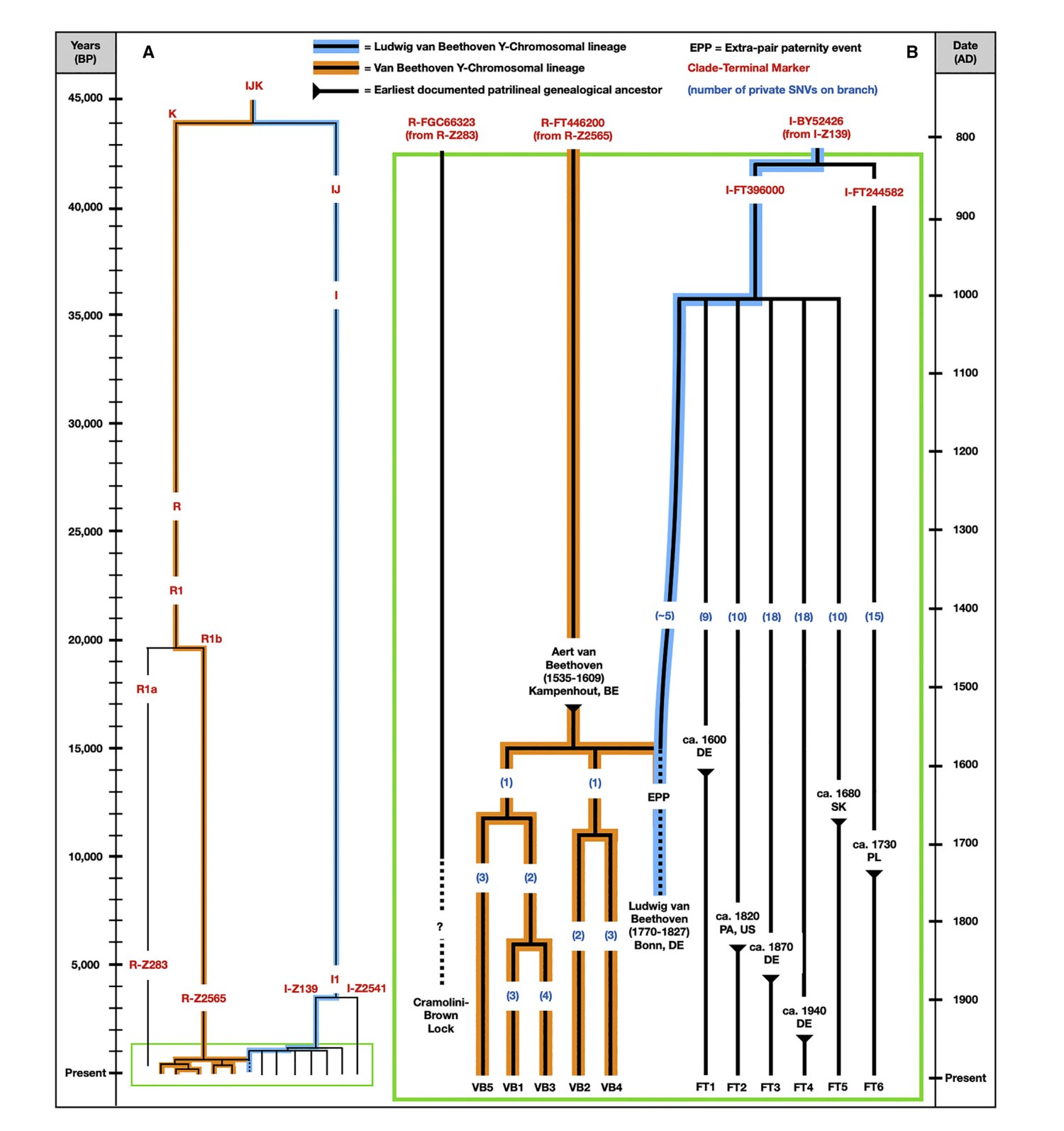
The Y chromosome is inherited father to son with almost no recombination, so a surname lineage and a Y lineage should travel together. Five living men carrying the Van Beethoven surname, who descend from a documented shared paternal ancestor, were tested. They match each other. They do not match the hair.
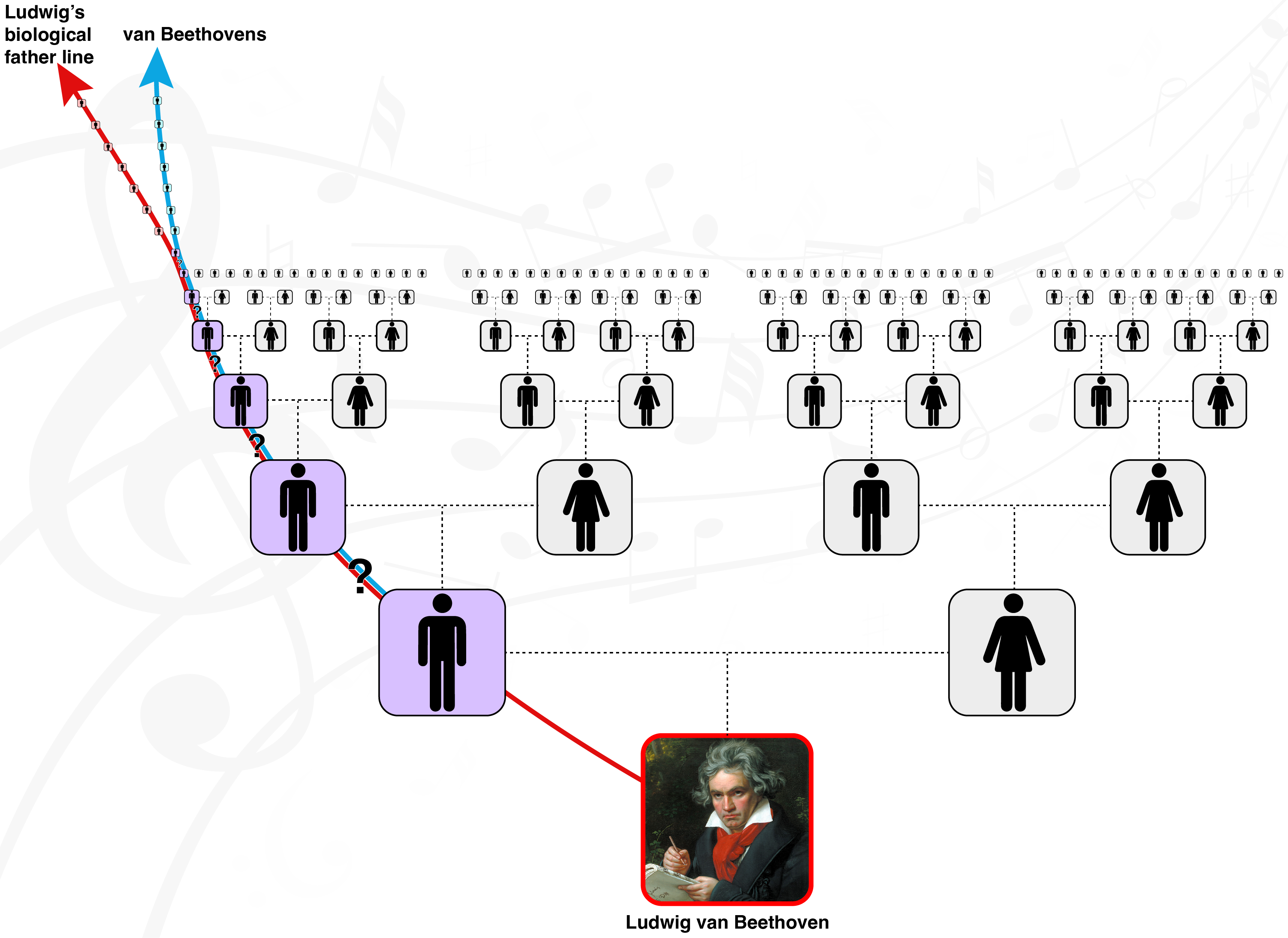
That means an extra-pair paternity event occurred somewhere in the direct patrilineage: at some generation, the man recorded as father was not the biological father. The genealogy is not wrong about who raised whom, only about who contributed the Y chromosome.
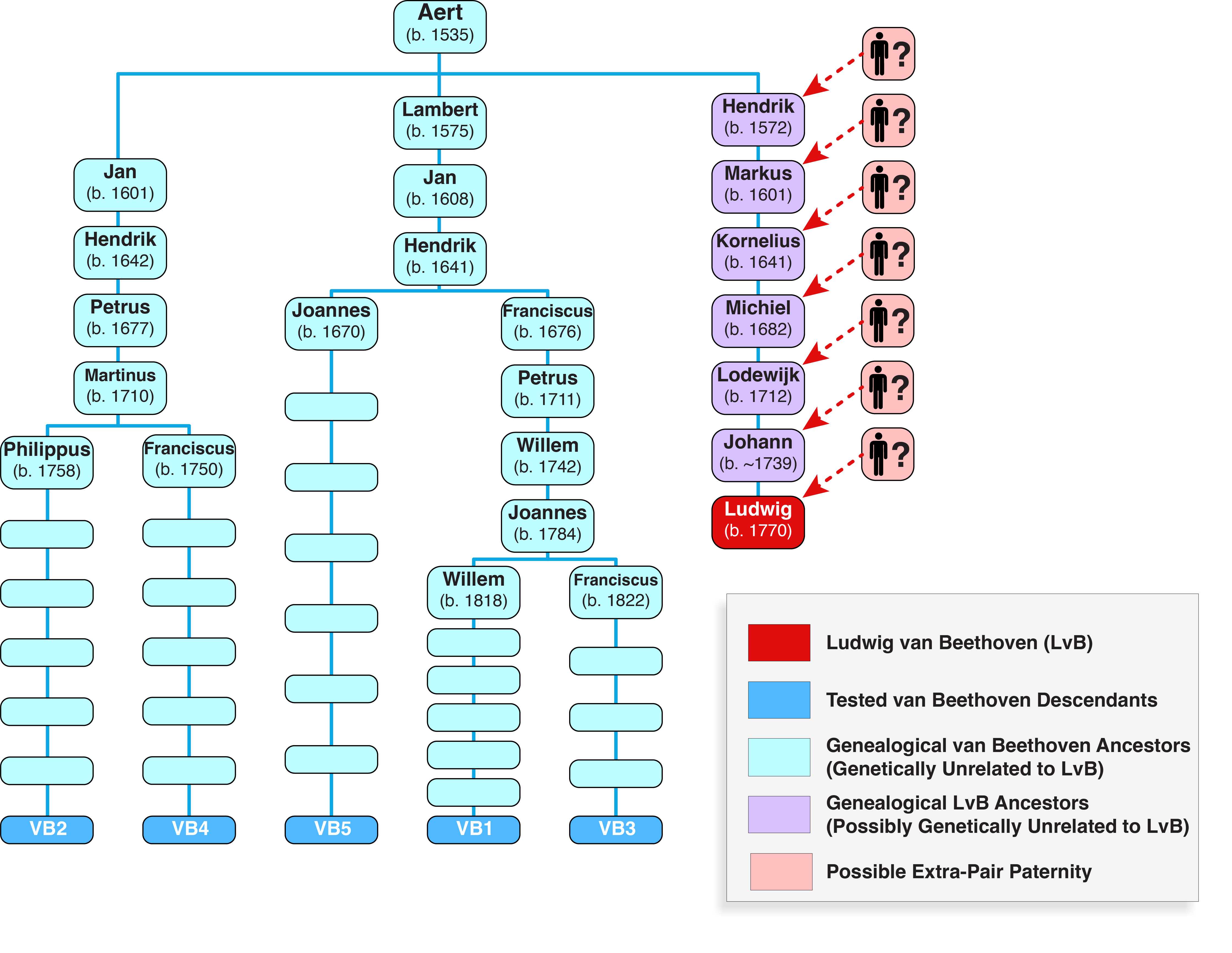
The pedigree narrows the window without closing it. The break falls somewhere between the conception of Hendrik van Beethoven in 1572 and Ludwig’s own conception in 1770, which spans seven generations. Nothing in the genetic data localizes it further, and the paper says so rather than picking a likely candidate. Events like this are common enough in any deep genealogy that the interesting part is not that one occurred, but that it can now be detected at all in a person who died two centuries ago.
Geo-genetic triangulation
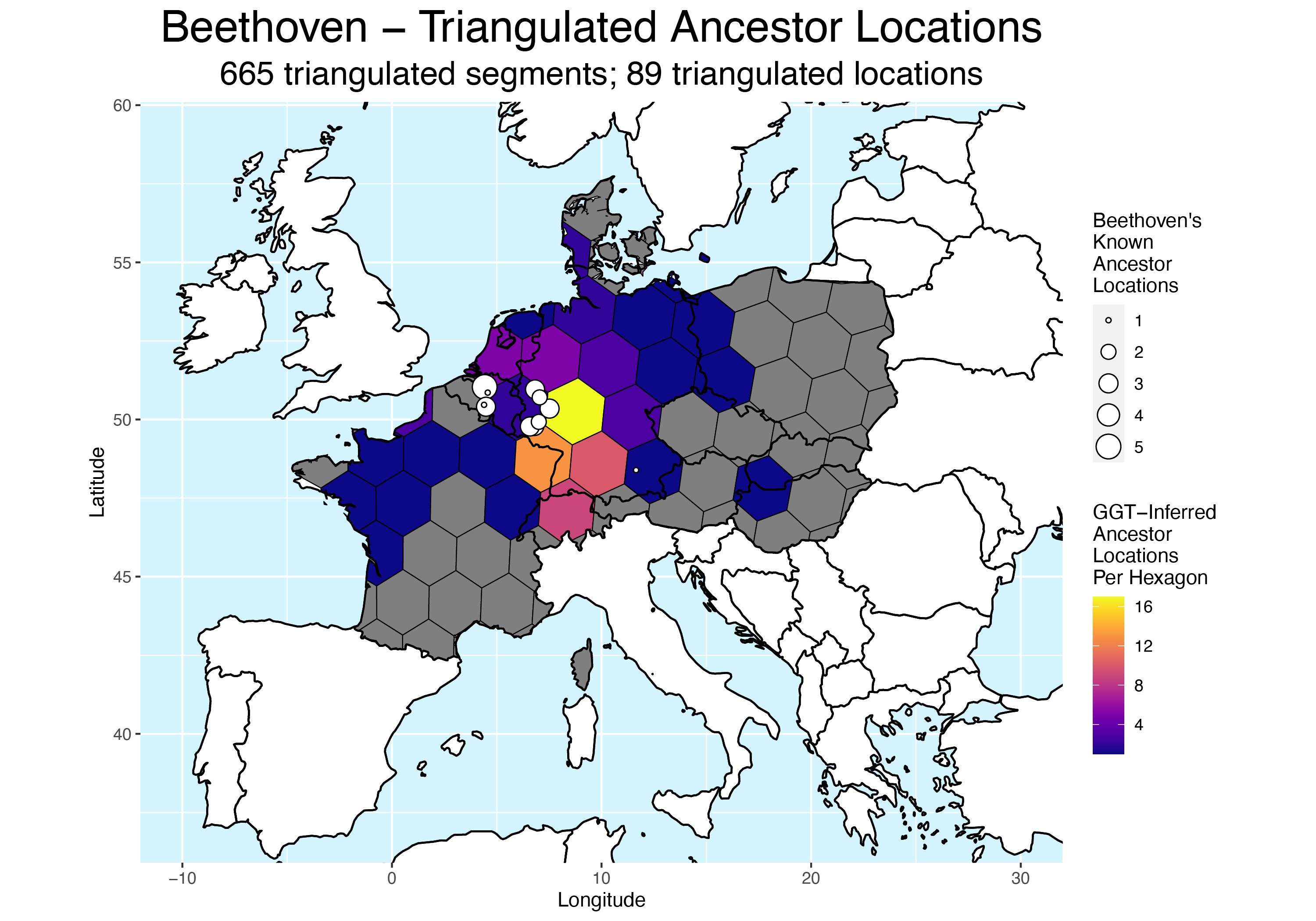
My contribution was the biogeographic side, and it needed a method that did not exist yet. The technique we introduced, geo-genetic triangulation, finds long identity-by-descent segments that Beethoven shares with people in a genealogically documented consumer database, then asks where those segments concentrate geographically once you correct for how heavily each region is represented in the reference data.
That correction is the crux. Without it, the answer is simply a map of where testing is popular. Run across hundreds of segments, the locations converge on a region rather than a point, which is the honest resolution of this kind of data and matches what Beethoven’s documented genealogy would predict.
Technical details
The team adapted existing ancient DNA protocols for historical hair, which enabled high-coverage sequencing from small sample quantities. Authenticity rested on concordance between independently sourced locks, assessed through relatedness testing across all eight samples.
Geo-genetic triangulation used long IBD segments shared with FamilyTreeDNA database participants who have documented genealogies, with location inference aggregated into hexagonal spatial bins and normalized against reference density per bin. 665 matching segments resolved to 89 triangulated ancestor locations.
Disease risk was assessed with polygenic scores compared against cohort baselines, and the hepatitis B finding came from metagenomic recovery of viral reads within the hair-derived sequencing data.
Two Holy Roman Emperors
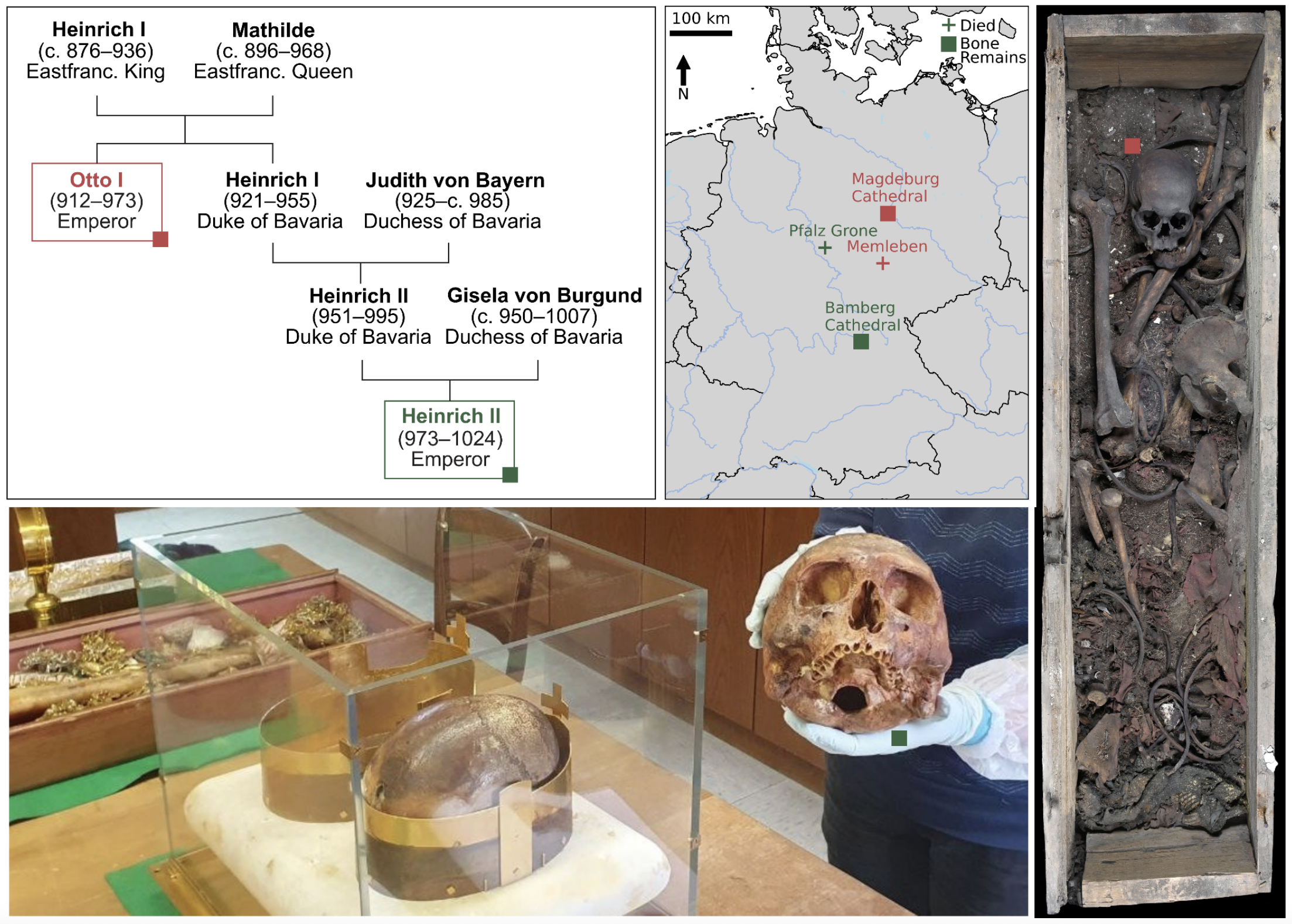
Otto I ruled from 912 to 973 and Heinrich II from 973 to 1024, the first and last emperors of the Ottonian dynasty. Historical records state they were related as great-uncle and grandnephew through the paternal line. Remains attributed to each are preserved in the cathedrals at Magdeburg and Bamberg, and the attribution had never been tested.
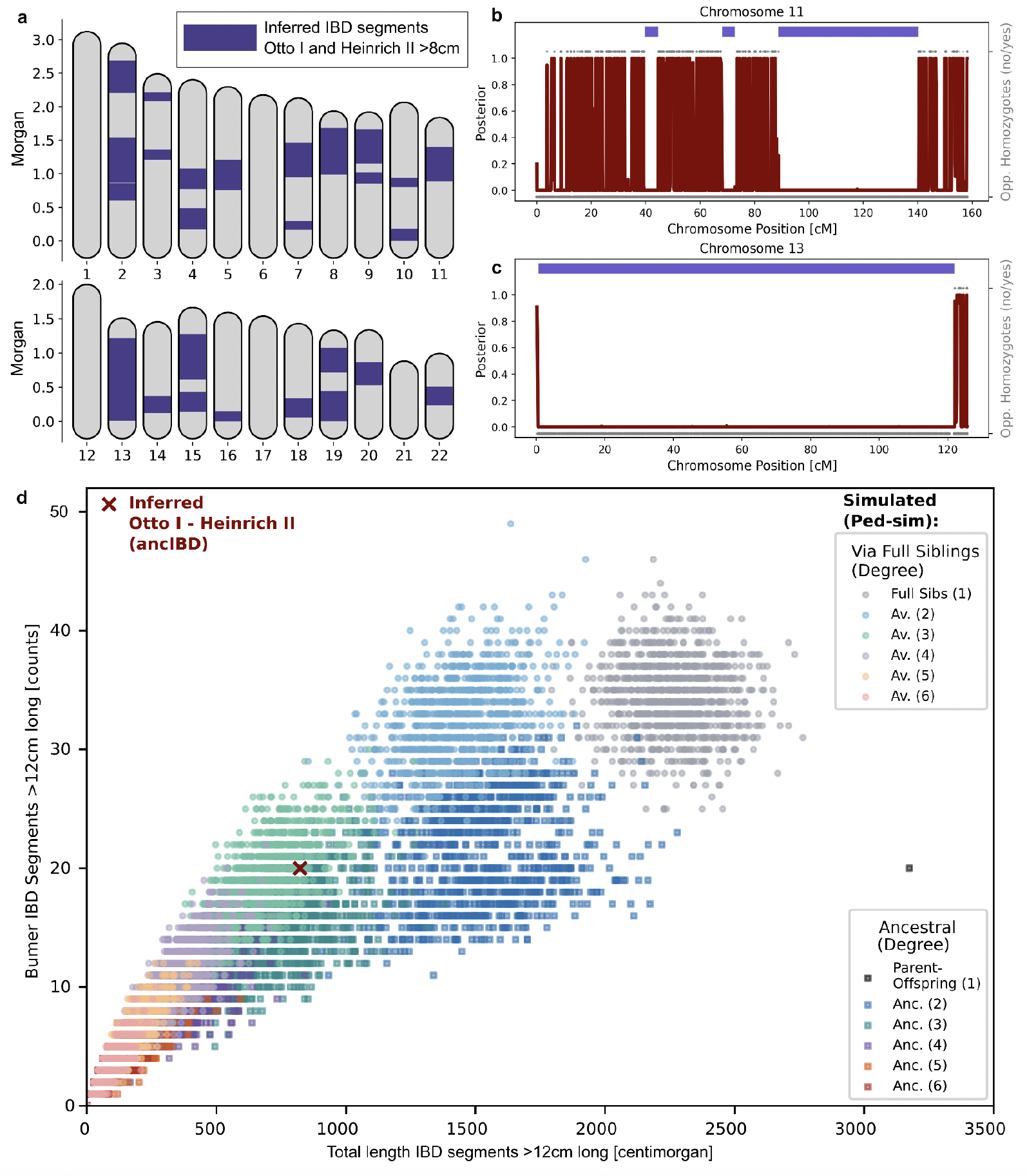
Whole-genome sequencing of both sets of remains identified a third-degree genetic relationship from shared DNA segments, with matching Y haplogroups. That is precisely what a great-uncle and grandnephew relationship predicts, and it effectively confirms the identification of both sets of remains.
The identification is not the most useful part of the result. Because the historical record supplies exact lifespans and dates of death for both men, authenticated remains become calibration material. Radiocarbon dating and skeletal age-at-death estimation can both be checked against a known answer, including the marine and freshwater reservoir effects that distort radiocarbon dates for individuals with particular diets. Ground truth of that quality is rare enough in bio-archaeology to be worth more than the question that motivated the study.
Technical details
Relatedness was inferred from shared IBD segment totals and lengths, compared against simulations of specific pedigree configurations rather than against a generic kinship coefficient, which is what allows a great-uncle relationship to be distinguished from other third-degree possibilities.
Both individuals assign confidently to Y haplogroup R-FTA63331. Its present-day
frequency was assessed against the FamilyTreeDNA Y-DNA Haplotree, where it appears at low frequency in
Germany, Denmark, the Netherlands, and beyond, which is consistent with a lineage that has persisted
regionally without expanding.
Gotland and Janakkala
Two ongoing collaborations apply the same toolkit to burial populations rather than named individuals, where there is no archive entry to check against and the genetics has to carry more of the argument.
At Ihre on Gotland, a Viking Age cemetery, the question is how biological relatedness maps onto burial practice. People buried near one another may be a family, a household, or a community organized on some entirely different principle. Grave goods and spatial layout cannot distinguish those possibilities; kinship inference from genomes can. That work is in review at PNAS.
The sword man from Janakkala is a single Iron Age burial in Finland, and the question is simpler: where did this individual come from, and how does he relate to the populations around him? That paper is in review at Fennoscandia Archaeologica.
Other individuals
The same approach has been applied to Ötzi the Iceman and to Abraham Lincoln, in both cases working from existing sequence data to place the individual within the wider phylogeny and infer where their lineages came from. Neither required new sequencing, which is a reminder that a meaningful fraction of ancient DNA work now consists of asking better questions of data that already exists.
Papers from this work
- Begg T.J.A., Schmidt A., Kocher A., Larmuseau M.H.D., Runfeldt G., Maier P.A., et al. (2023). Genomic analyses of hair from Ludwig van Beethoven. Current Biology 33, 1–17. DOI · PDF · New York Times
- Ringbauer H., Wozniak T., Feuchter J., Runfeldt G., et al., Maier P., et al. Reconstructing their genomes confirms the historically attested genealogy of the two medieval emperors Otto I and Heinrich II. In preparation. DOI
- Ivarsson-Aalders M., Krzewińska M., Varela R.R., Yaka R., Burke A., Sager M., Maier P., Runfeldt G., Kjellström A., Götherström A. Between kin and community: biological relatedness and belonging at Viking Age Ihre, Gotland. PNAS, in review.
- Götherström A., Vicente M., Pochon Z., Kjellström A., Sager M., Maier P., Runfeldt G., Storå J. The sword man from Janakkala: a genomic analysis of his ancestry. Fennoscandia Archaeologica, in review.